


Training tutors in a mastery approach means soldiers gain the maths qualifications they need to progress in their careers
‘I can’t do maths’, ‘I was never any good at maths’ and ‘I gave up on maths when I failed GCSE’ might be familiar refrains by some adults who were turned off the subject at school. But what happens when having a maths qualification becomes necessary for your next career step? And when maths underpins crucial elements of your job?
MEI’s ‘Maths Mastery in the Army’ course helps to upskill the trainers who are delivering functional maths to soldiers who need to pass a maths qualification to gain promotion in the British Army. By equipping the teachers and Basic Skills Development Managers (BSDMs) with new ways to think about and teach mathematical concepts, MEI are helping those with a desire to reconnect with maths to gain the vital skills and qualifications they need to pursue their career in the Army.
The challenge of supporting the lowest maths achievers
According to the 2023 PIAAC Survey of Adult Skills, on average, adults in England have better numeracy skills than those in other OECD countries. However, the adults who score lowest for their numeracy are actually performing worse than their counterparts in other countries. Whilst adult numeracy in England has shown an improvement in scores since 2012, the lowest achievers’ skill level has remained unchanged, widening the gap between the top and the bottom. Supporting those adults who lack confidence in maths, have maths anxiety, or have had negative experiences of maths in school is, therefore, both very important and very challenging.
When recruits join the Army, they arrive with a wide range of maths qualifications, often reflecting this wide skill gap between those who have and haven’t achieved well in maths at school. Some may have a degree in the subject, whereas some may have failed their maths GCSE multiple times. Everyone undergoes the same basic training, whether they are looking to become an engineer, a chef or an infanteer. Without Functional Skills Maths (and English) at Entry level 3, soldiers cannot progress from Soldier Basic Training to Initial Trade Training. And the expectations of demonstrating the numeracy skills necessary for the job don’t stop there. To become a corporal, level 1 Mathematics and English are required, rising to level 2 (equivalent to a grade 4/C at GCSE) for those wanting to achieve the rank of sergeant or higher.
To build their skill level, if they do not already have the required skills or qualifications, the initial basic training block will begin with four weeks of literacy and numeracy. The motivation to achieve Entry level 3 Functional Skills Maths and progress into initial trade training, which allows soldiers to specialise in their career of choice, means pass rates are high. But many have had negative experiences of maths in the past, and report being told that they were no good at it, repeatedly failing exams, and even being sent out of the classroom during a maths lesson. To support these learners, tutors must be adaptive and responsive, building soldiers’ confidence and giving them new ways to explore mathematical concepts.
Education and training are central to the soldiers’ experience. This course ensures their tutors all give soldiers the same opportunities in their maths learning.
Sue Thain
Building soldiers’ confidence in maths
The teachers and tutors delivering maths in the Army have a range of backgrounds themselves, with some coming from a career in teaching and others developing teaching skills on the job. Tutors are also teaching maths alongside and as part of apprenticeships, meaning they are juggling subject knowledge and pedagogy across a range of areas (the Army offers 41 different apprenticeship programmes). In addition to keeping their own knowledge up to date, many tutors face the challenge of teaching soldiers who speak English as an Additional Language (EAL), or who have high levels of dyslexia, meaning even understanding a question may prove difficult, let alone tackling the maths behind it.
Being able to build individuals’ confidence about the maths they are already using is crucial, and tutors spend time linking real-life examples to mathematical concepts and processes. Soldiers are helped to see how the maths they are learning applies directly to their role. Calculating time, speed, weights, and distances are all essential skills in a military context. They are using their mathematical skills in their job, not just learning concepts to pass an exam.
The role of MEI
After changes to the Functional Skills Maths exams in 2019 and the introduction of the stretch programme for Apprenticeship completion, the Army saw a dip in the pass rate and wanted to ensure that soldiers were being given the best possible chance to gain mathematical skills and confidence to carry out their roles as well as pass the qualifications they needed to pursue their careers. The key to this was ensuring tutors were as equipped as possible to match their teaching to the particular requirements of the learners in front of them. Sue Thain, the Army Skills Delivery Lead in the Army’s Education Branch, got in touch with us to find out how MEI’s course ‘Maths Mastery in an Adult Setting’ could be adapted for the specific needs of their tutors.
‘Maths Mastery in the Army’ was developed, offering participants six online sessions where they could learn about the pedagogy of mastery in an adult setting. The course looks at reasoning, problem solving, number sense and fluency, and gives participants the chance to share best practices and discuss their teaching techniques.
‘Many of our tutors work in isolation’, Sue explains. ‘Our BSDMs might have met in the CPD sessions that we offer, but we also have contracted tutors who haven’t accessed that in the past. The MEI course offered an opportunity to bring together representatives from all the organisations involved in delivering maths to soldiers to discuss what and how they teach. It means that all their learners have parity of opportunity, because everyone delivering Functional Skills Maths has had the opportunity to learn how mastery can work in our unique setting.’
An online session on ‘Responsive Teaching’

In the second of the six sessions, participants begin by joining a discussion in breakout rooms. The task – feeding back on what they have tried since the first session on ‘Engagement and Building Confidence’ – quickly turns to a conversation about some soldiers’ low confidence and how tutors have been encouraging them to overcome it. One participant talks about the need to ‘reset their [soldiers’] mindset’ by giving learners a chance to apply maths to their daily experiences and see that they are already using it frequently and competently. A word cloud of what ‘responsive teaching’ is then leads to a group discussion about what ‘adaptive’ really means and how tutors take different approaches to adapting their planning and teaching. They share that many of them have heard the familiar complaints – ‘I was told at school I was no good at maths’ – and that a large part of their job is to help soldiers reconsider their relationship with numeracy.
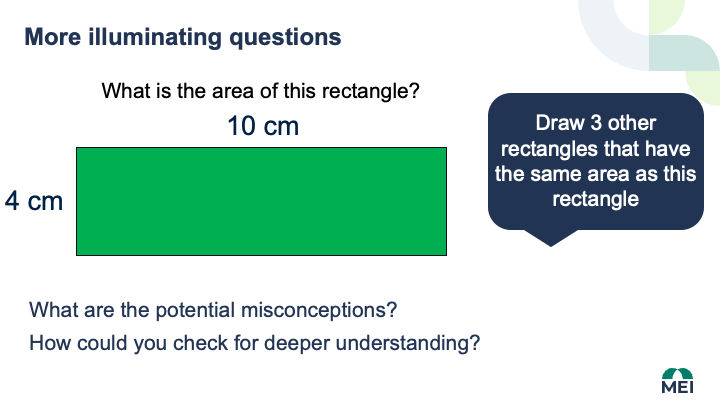
This is an example of a mastery-type questioning approach, where participants look at a traditional skills and knowledge question. They then explore a questioning technique that encompasses reasoning and deeper understanding, and unearths common misconceptions by developing more illuminating questions, such as the one in the picture.
Over the following weeks, participants on the course explore the ‘Five Big Ideas’ in teaching for mastery, looking at how representation and structure, fluency and variation, and mathematical thinking can give the soldiers new ways of looking at mathematical concepts.
This is the second year that the Army have run the course, and the first year that contract tutors have taken part along with BSDMs. Participants are enjoying the opportunity to meet colleagues who may be geographically remote, and to share their experiences and ideas. With a raft of new tools and approaches for the teachers, the soldiers are now benefiting from an organisational commitment to develop their mastery of maths skills.
Find out more
If you teach maths in an adult setting and would like to know more about the benefits of a mastery approach, visit our Maths Mastery in an Adult Setting webpage to learn more. We can adapt our course to meet the requirements of your unique setting.