


Tom Button, MEI’s Director for Data Science and Mathematics Technology, responds to proposals in the recent Curriculum and Assessment Review
The Department for Education’s response to the 2025 Curriculum and Assessment Review stated: “We will … explore the development of a level 3 qualification in data science and AI.” At, MEI, we were very pleased to see this intention. It is in line with our thinking and consistent with our activity in this area over the last few years.
In this blog post, I’ll outline MEI’s case for a new qualification for level 3 Qualification in Data Science and AI. Our expertise in the maths that underpins AI, and the successes of our past and current courses for students and teachers, suggest there is strong demand and enthusiasm for such a qualification. If it is to be a success, it has to be designed with care to meet the needs of students. It must also be supported by effective professional learning opportunities for teachers and leaders in schools and colleges.
Why is there need for a level 3 qualification in data science and AI?
The launch of ChatGPT 3.5 in 2022 sparked huge interest in Artificial Intelligence (AI). Less than three years later, AI tools, including large language models, are embedded in many aspects of modern life. This apparent ‘explosion’ of AI is based on developments in machine learning over the last 20 to 30 years. It has been made possible with the increase in available data and significant advances in processing power.
Whilst it is of course important that education prepares students for the world in which they will live, study and work, it is essential that students develop a deeper understanding of AI beyond large language models. Machine learning techniques are already being used in advanced fields including climate modelling, health and energy: indeed, the Nobel prize for chemistry in 2024 was awarded to three machine learning engineers.
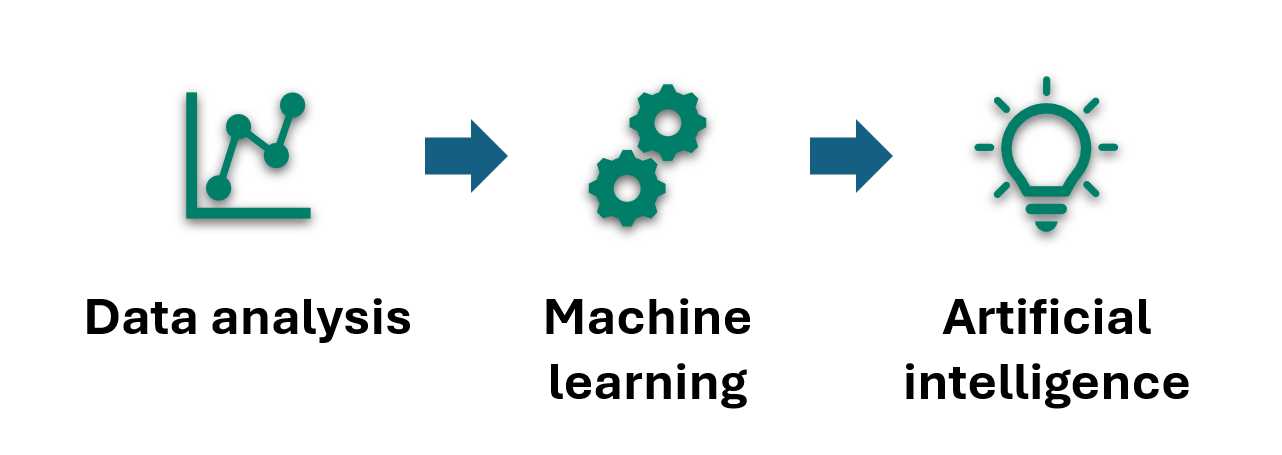
This awareness of the wide scope of artificial intelligence and the importance of machine learning is reflected in the DfE’s response to the C&A Review – that the aim is to work towards a qualification in ‘data science and AI’ and not just ‘AI’. It is difficult to fully appreciate the strengths and weaknesses of AI without an appreciation that most modern AI tools are built using machine learning approaches to analyse huge quantities of data. The narrative of ‘Data analysis -> machine learning -> AI’ is central to helping students understand how AI works.
In his recent book ‘How Machines Learn’, the author Anil Ananthaswamy argues that:
We cannot leave decisions about how AI will be built and deployed solely to its practitioners. If we are to effectively regulate this extremely useful, but disruptive and potentially threatening, technology, another layer of society – educators, politicians, policymakers, science communicators, or even interested consumers of AI – must come to grips with the basics of the mathematics of machine learning
Anil Ananthaswamy
How would the qualification work?
Whilst there are many places in the school curriculum where students could develop this knowledge and understanding of the mathematics of machine learning, MEI supports the introduction of a new Level 3 qualification. At this post-16 stage of education, students will have acquired the necessary knowledge, skills and maturity to understand some of the contexts in which data science and AI are applied. We recommend that the qualification is smaller than existing A levels so that it is feasible for students to take it alongside three A levels, or equivalent-sized programmes.
We believe that any data science and AI qualification should be worth UCAS points, so it is attractive to students. It is also important that programmes that include the qualification should attract a funding premium to enable all schools and colleges to offer it. Ideally the qualification should be appealing and accessible both to students taking A level Mathematics and those who are not.
In tandem with this new qualification, MEI also recommends changes to the current statistics content of A level Mathematics, and the teaching of data throughout the whole school curriculum, so they fully reflect the technology-based way that data is processed in the 21st century. We echo the point made in the Royal Society’s response to the Curriculum and Assessment Review:
To change this, we need a radical approach to maths and data literacy across all age groups. It must be underpinned by digital technologies and fuse maths, statistics and data science.
The Royal Society
How can it become the right qualification?
MEI has been developing data science courses since 2019. We have produced a short self-study course for A level Mathematics students and a longer, taught course, which is assessed.
Between 2021 and 2025, over 1,500 students enrolled on this taught course, with more than 500 completing the optional assessment to obtain a certificate. More than 40% of the students who have completed it identify as female or non-binary. This is very promising given that the course includes programming, which is often considered a male-dominated area.
Our experiences highlight the importance of developing the curriculum, resources and assessment in parallel so that all three aspects support each other. We have been driven by identifying key aims for the course: to develop students’ knowledge of how maths and statistics underpin machine learning and AI, and to support their future study/careers by developing practical skills in modelling with real data. These aims are embedded in course content, materials to support learning, and assessment tasks. Any future Level 3 qualification in data science and AI should develop these aspects in parallel.
Course outcomes can only be achieved through a practical element. Key issues encountered in data science, such as effective preparation and cleaning of data, need to be explored through experience with real data sets. In our taught course, students engage with real data throughout and use Python to work with data in an assessed practical task. They have fed back to us that they appreciate the experience of using a ‘real-world’ technology.
In developing our course, we were helped by working with computing education experts. This model of collaboration should be reflected in the development of the new qualification: data science and AI sit in the overlap between the existing subjects of Mathematics and Computer Science, and benefit from the input from both communities of educators.
In 2025/26, MEI developed the taught course into a ‘Maths into Data Science and AI’ course. It has already proved hugely popular: over 1,000 students have enrolled on the course this year, including both students who take A level Mathematics and those who don’t. This is for a course that currently doesn’t have UCAS points (though we often get asked this!). The demand for a data science and AI qualification at Level 3 clearly exists.
How should teachers be supported?

Any future qualification in data science and AI would need to draw on a diverse range of teachers to teach it. These teachers will need to be supported with high-quality subject-specific professional development.
MEI has a significant track record and deep expertise in supporting teachers. We are well placed to work across the sector to provide professional development to implement the new qualification. In tandem with our courses for students, we run ‘The Maths of Data Science and AI’ for teachers. This professional learning course explores how maths is used in the development of machine learning and AI, and how these ideas can be integrated into the teaching of A level Mathematics. You can find out more about this course on the AMSP website.
Our experiences of running this PD course have shown us that there is a real demand from teachers to keep their subject knowledge up-to-date and to provide the best possible opportunities for their students. As a result, we are expanding the course to welcome teachers of A level Computer Science in 2026.
What’s Next?
We are excited that the government is exploring a new qualification in data science in AI. We believe that Level 3 is the appropriate level for this qualification, and that development should run in tandem with developing an approach to teaching data throughout the curriculum. Such a qualification should be developed by thoroughly trialling the curriculum, resources and assessment, and be supported by a programme of professional training for teachers. It is essential that the mathematics education community has a significant role in the development of this qualification.