

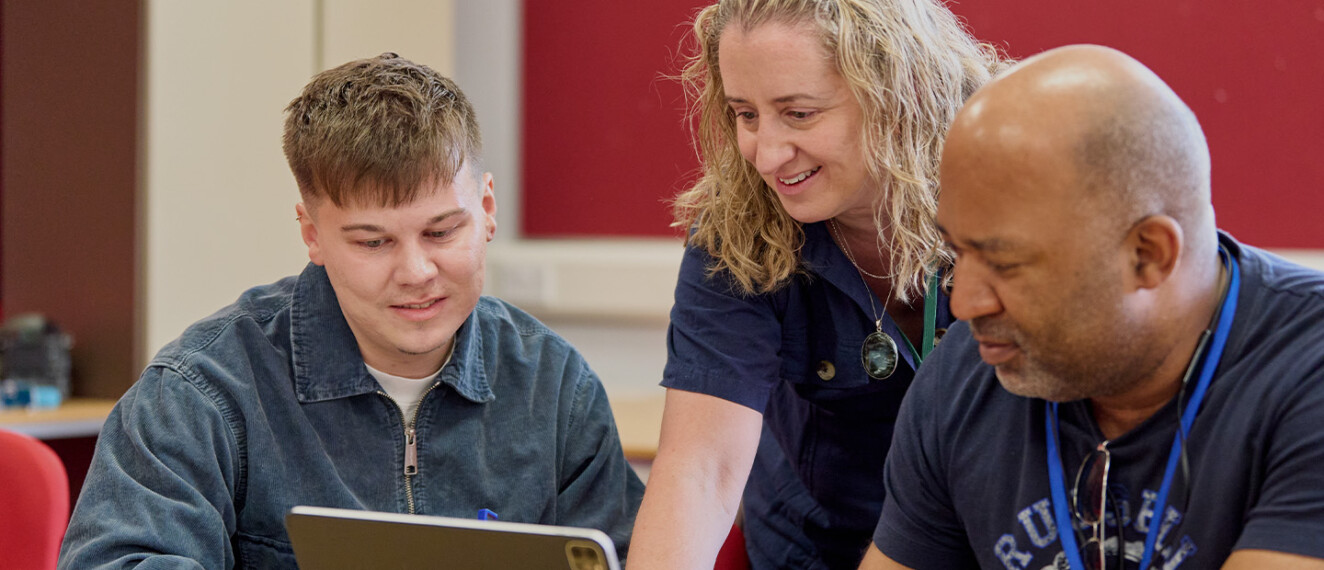
Focus Question: How can we help students tackle their maths gaps post-diagnostics?
Introduction
The new academic year saw a significant change in our Further Education Maths CPD Programme, and we were happy to introduce our National Online Events. Our first event, held on 22 October, asked: How can we help students tackle their maths gaps post-diagnostics?
Below, you can find out about what we explored and some of the insights discussed in our breakout sessions.
1) Exploring the Question
This session focused on how diagnostic information can be used meaningfully to support learning, rather than simply to label or group students. The session challenged the idea that post-diagnostic work is about “plugging gaps” and instead framed diagnostics as a way of understanding how students are thinking about maths, what they are ready to learn next and how teaching can be adapted in response.
We explored a range of diagnostic approaches, from formal tools such as Question Level Analysis and published assessments to teacher-generated checks for understanding and careful questioning. Participants reflected on the balance between structured diagnostic tools and classroom-based assessment for learning, with the key message that the most powerful insights often come from what students say and do during teaching, not just from assessment results.
The session also highlighted the importance of classroom dialogue and tasks which reveal reasoning, not just answers. Through examples drawn from pricing and value comparisons, colleagues explored how carefully chosen problems can uncover misconceptions, promote discussion and help teachers see not only what learners know, but how they are thinking.
2) Discussion and Collaboration
Mentimeter responses showed a wide range of tools currently being used for diagnostics, including commercial platforms, exam papers, in-house assessments and formative checks in lessons. When asked about the biggest gaps in learners’ skills, common themes emerged across colleges: algebra, fractions, ratio, percentages and multiplicative reasoning featured most strongly.
In breakout discussions, colleagues were frank about the difficulties they face once gaps have been identified. Time pressure, mixed-ability groups, attendance issues and large class sizes were all seen as barriers to acting effectively on diagnostic information. Many also noted the challenge of supporting students across a wide grade range within the same class, particularly when working with learners who have previously achieved a grade 3 alongside those with very low prior attainment.
Despite these challenges, the discussion was rich with practical ideas. Colleagues shared strategies, including:
- using short diagnostic starters to inform lesson planning
- breaking learning into smaller conceptual steps
- providing targeted support through small-group work
- using low-stakes quizzes and retrieval activities
- creating a culture in which mistakes are expected and explored.
There was a strong collective message about building learner confidence through talk, explanation and peer discussion, as well as helping students see diagnostics as a starting point for success rather than a judgement on ability.
3) Shared Links and Resources
Resources which were shared during the session include:
- Don Steward’s ‘Best Buys’ comparison tasks
Practical problems that support diagnostic insight through discussion around value, ratio and proportional reasoning.
https://donsteward.blogspot.com/2019/02/best-buys.html - NCETM Checkpoints
Structured tasks designed to reveal pupils’ thinking and misconceptions through carefully designed questions.
https://www.ncetm.org.uk/classroom-resources/checkpoints/
Join us for our next event
We are grateful to everyone who joined us for our first National Online Events, and we look forward to seeing you at our next event.